Why a two-line rule beats seven tuned models
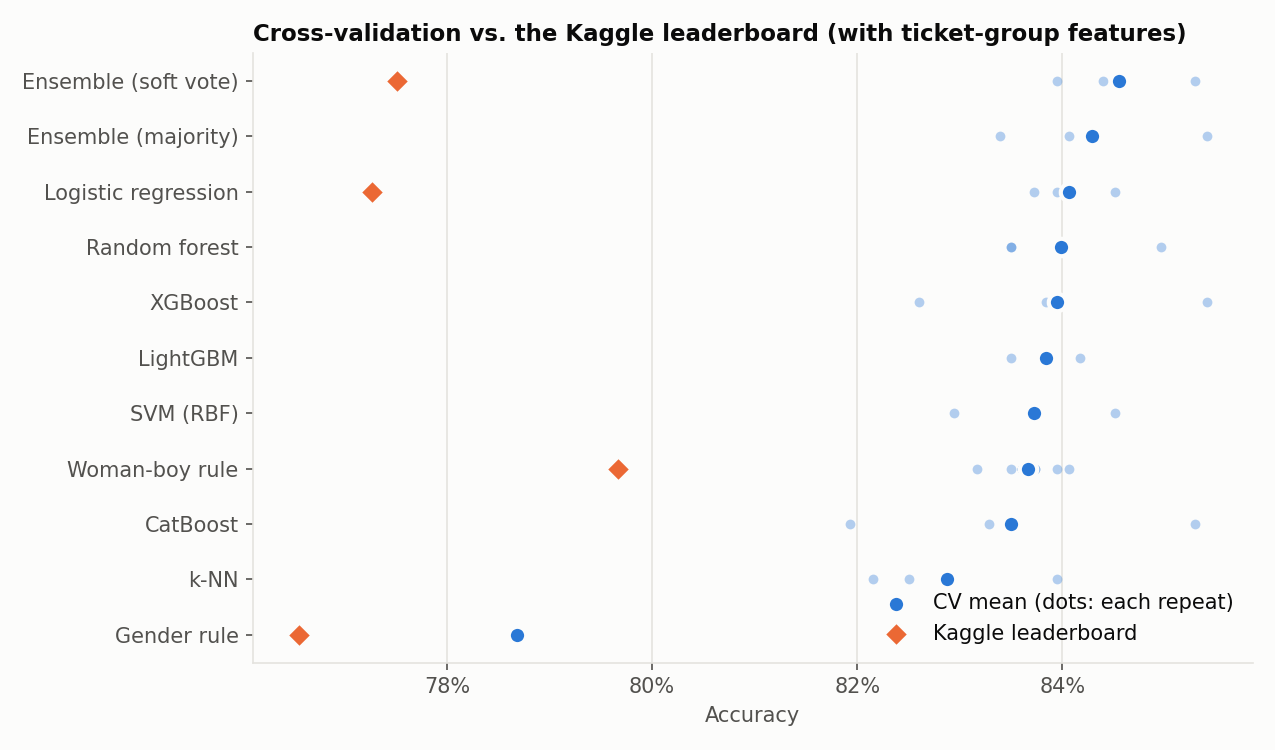
The Kaggle Titanic competition: 891 passengers to learn from, 418 to predict. Seven model families with nested cross-validation reach 84% accuracy in CV and land at 77% on the leaderboard. A rule built on the gender baseline plus one family correction scores 79.9%. This page explains the gap.
01Cross-validation vs the leaderboard
Nested CV (outer 5-fold x 3 repeats, inner grid search) for the models, 5-fold x 10 repeats for the rules. Kaggle scores all 418 test passengers, so one passenger is 0.24 points.
| Submission | CV | Kaggle |
|---|---|---|
| Gender rule | 0.787 | 0.76555 |
| Woman-boy rule, family groups (chosen by CV) | 0.840 | 0.79904 |
| Woman-boy rule, ticket groups | 0.837 | 0.79665 |
| Ensemble (soft vote, 7 models) + ticket groups | 0.846 | 0.77511 |
| Logistic regression + ticket groups | 0.841 | 0.77272 |
| Ensemble (soft vote), no groups | 0.835 | 0.76794 |
| XGBoost, no groups | 0.837 | 0.76076 |
| LightGBM with a leaking group feature | 0.986 | 0.64114 |
02The models' bets are a coin flip on new passengers
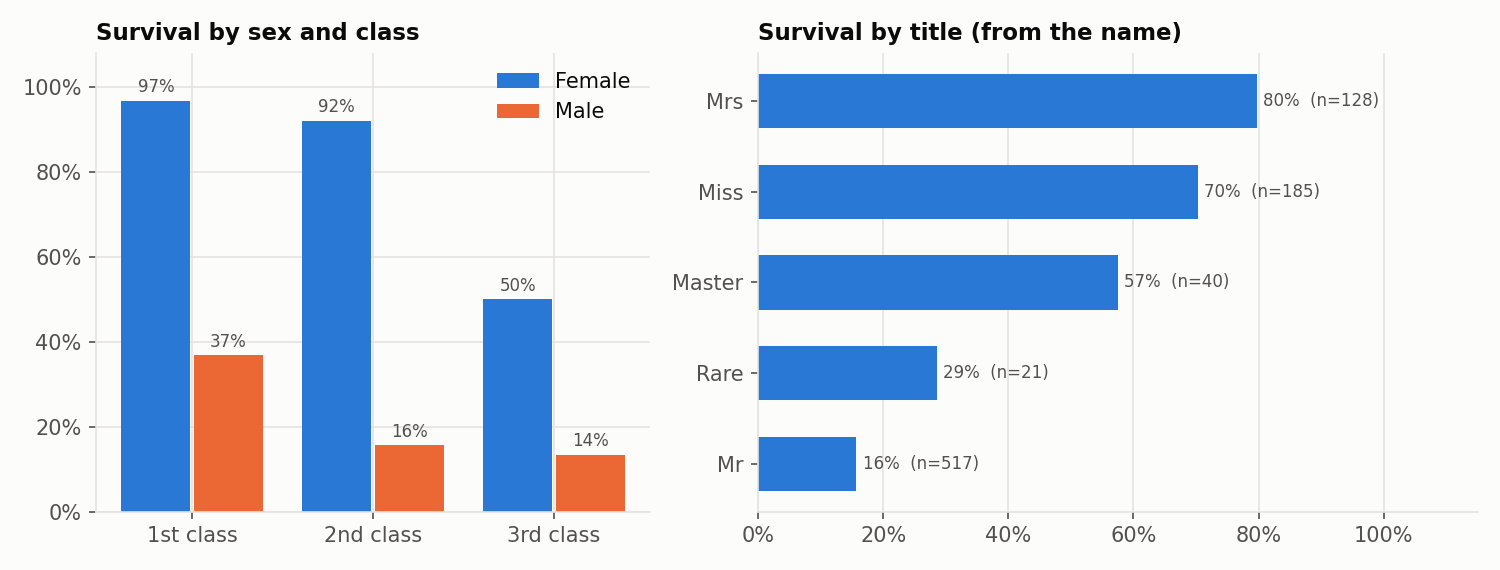
Sex alone explains most of the outcome, so every model is the gender rule plus a few dozen bets: a man predicted to survive, or a woman predicted to die. Since the gender rule was submitted too, the value of the bets on the test set follows from the two scores, net correct = (score − gender score) × 418, without any test label.
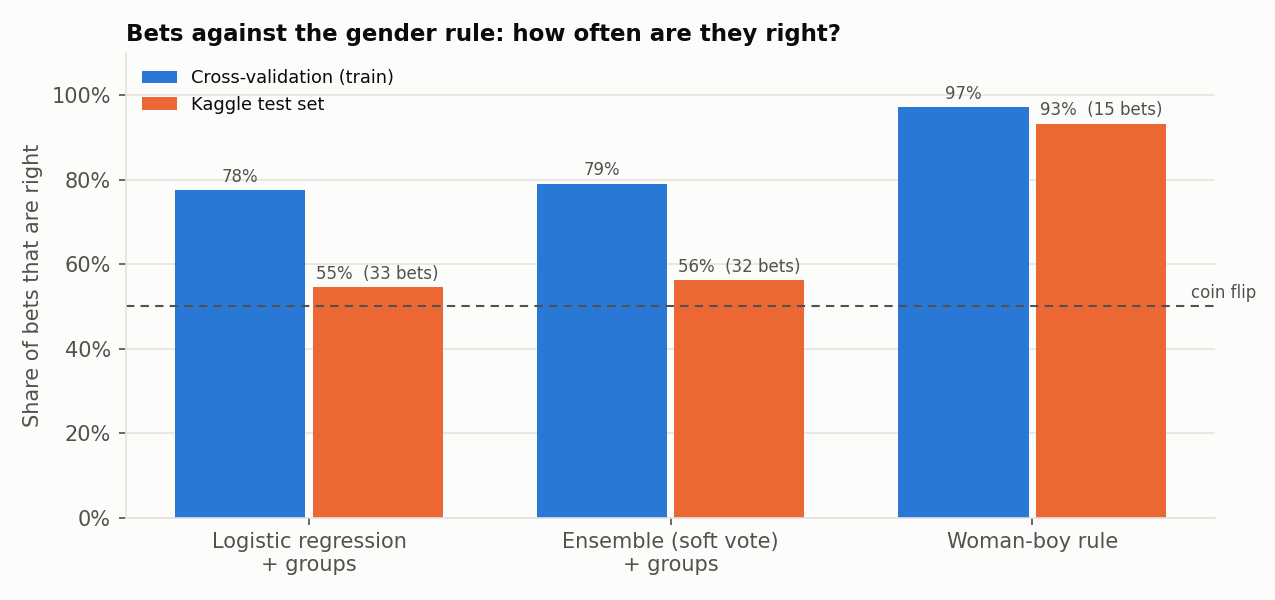
The gender rule has nothing to fit and still drops two points from CV to Kaggle, one standard error on 418 passengers. The models drop six to seven, so roughly four points are bets that do not generalize. Hyperparameter tuning adds only 0.5 points of optimism on average.
03The useful feature is also the one that leaks
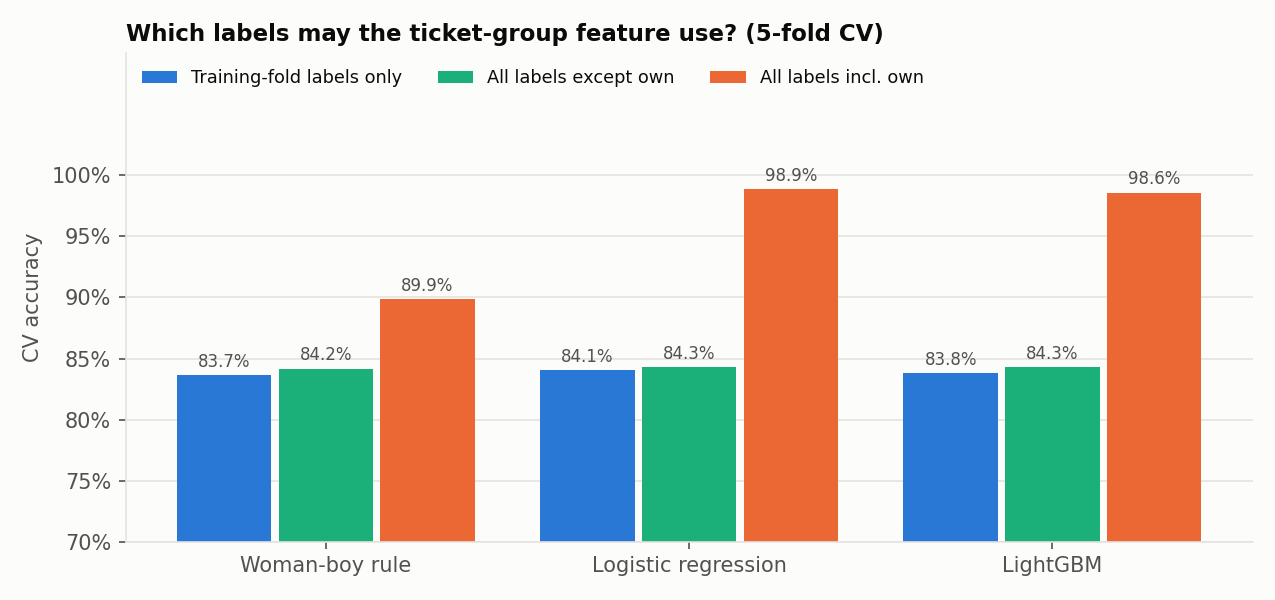
596 of the 1,309 passengers share one of 216 tickets, and 152 test passengers share a ticket with someone in training. A passenger's ticket-group feature is the survival rate of their ticket mates, and the labels it may use decide what CV reports.
04With 891 rows, model choice is noise
Fold-to-fold standard deviation is about 2 points, and XGBoost moves from 0.826 to 0.854 between CV repeats. All seven tuned families land between 0.829 and 0.841; on the leaderboard the ensemble beats logistic regression by one passenger.
05Family, not ticket
A ticket links companions who are not family and splits families who bought separate tickets. On the same 100 folds (5-fold x 20 repeats), grouping by family key (surname + class + ticket without its last digit + fare + port) lifts the rule's CV from 0.836 to 0.840, better in all 20 repeats; linking by either key gives 0.840 too.
| Group | Rule CV | Bet precision (CV) | Kaggle |
|---|---|---|---|
| Same ticket | 0.836 | 97.3% | 0.79665 |
| Same family | 0.840 | 98.0% | 0.79904 |
| Linked by either | 0.840 | 97.5% | not submitted |
The family grouping was chosen on CV and submitted once. It changes 3 test predictions and gains one passenger on Kaggle (15 of its 16 test bets right): the same direction as CV, but one passenger is within the noise.
06Caveats
- 418 test passengers make any leaderboard difference below about four points fragile; the bet analysis shows the direction of the gap, not its exact size.
- No model was chosen with leaderboard feedback: the first seven files came from one pipeline run and were submitted together; the family rule was picked by CV and submitted once.
- The public score covers the whole test set, so there is no private score to check against.