⛏️ Chile Mining -- Grade Control & Blast Quality (.NET)

A native C# / ML.NET data science solution for copper grade estimation and blast fragmentation quality, built and opened directly in Visual Studio

This page shows the project's results. The methodology, the design decisions and the limitations are documented in the repository's README.

7.1 Grade estimator: comparing regression trainers honestly
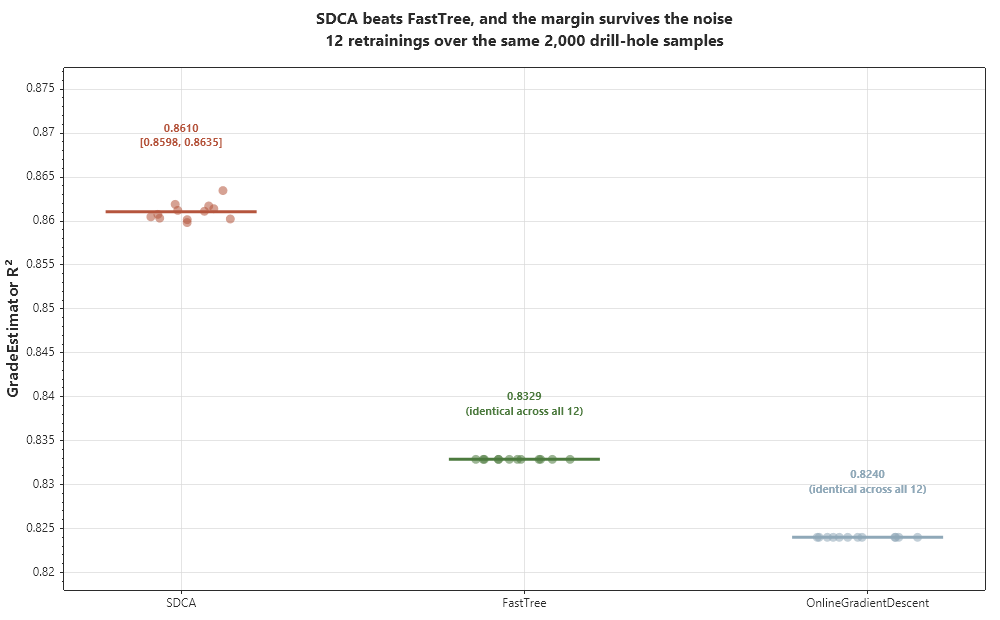
Trainer comparison across 12 retrainings
And the comparison holds up to being repeated, which is worth checking before acting on a 0.027 R² difference. Over 12 retrainings on the same 2,000 samples, FastTree returns 0.8329 every single time and Online Gradient Descent 0.8240 every single time — both are deterministic here. SDCA is not: it lands in [0.8598, 0.8635], a spread of 0.0036. Its worst run still beats FastTree's fixed value by 0.027, roughly 7x its own spread, so the ranking is not an artifact of a lucky draw. What *is* a single draw is the headline 0.860; the honest summary is "SDCA ≈ 0.861 ± 0.002, FastTree exactly 0.8329".

7.2 The classifier metrics are not a fixed number
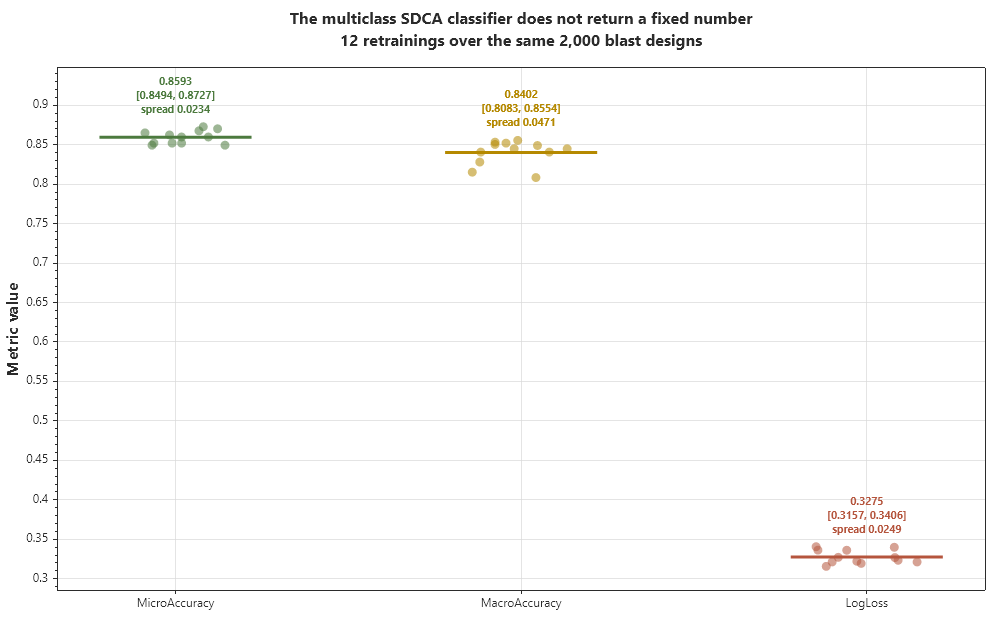
Fragmentation classifier metrics across 12 retrainings
The same non-determinism that affects SDCA regression affects FragmentationClassifier, which is multiclass SDCA. Over 12 retrainings on identical data:

7.3 Out-of-sample checks on both regressors
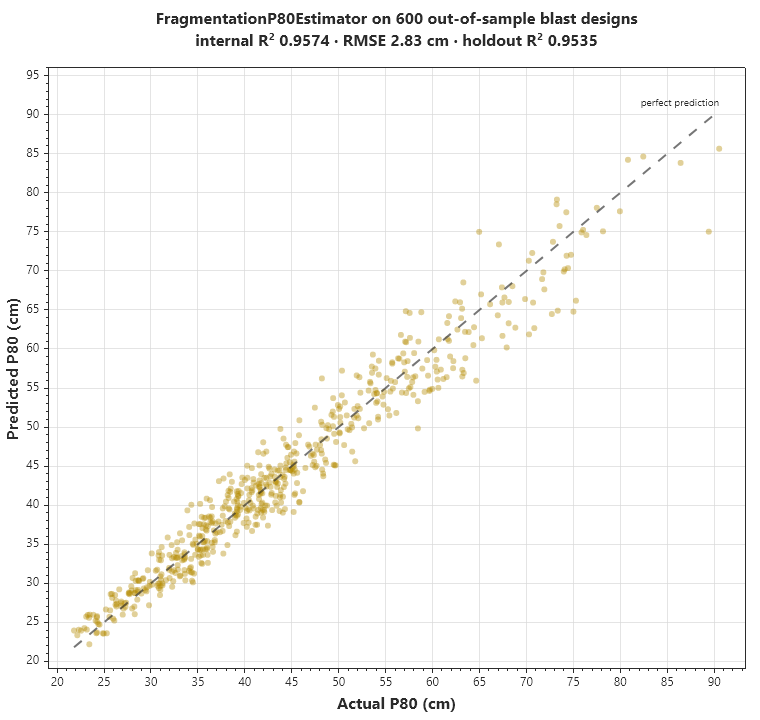
P80 predicted against actual on the fresh holdout
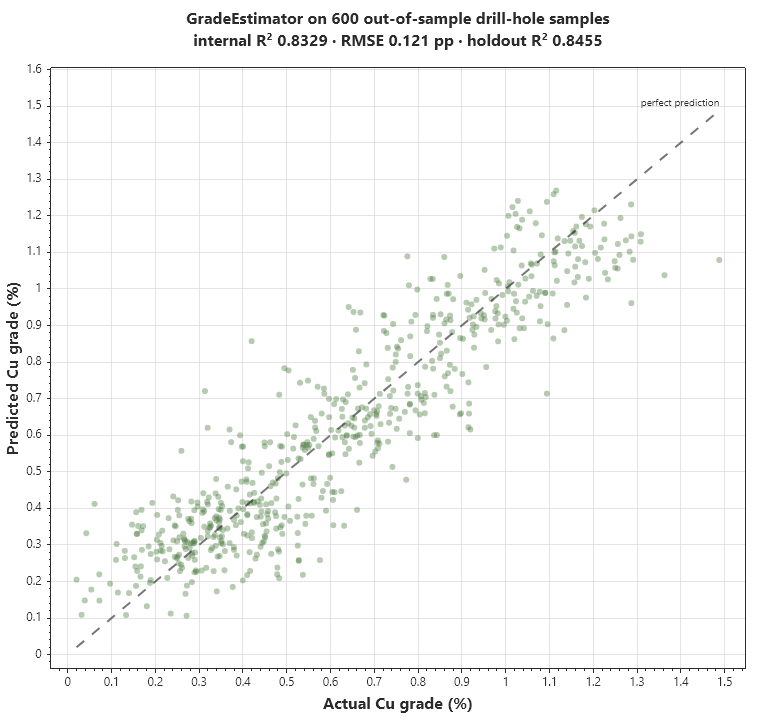
Both hold up: P80 loses 0.004 R² out of sample and the grade estimator actually gains 0.013. Neither is overfitting its split.
Cu grade predicted against actual on the fresh holdout
Both hold up: P80 loses 0.004 R² out of sample and the grade estimator actually gains 0.013. Neither is overfitting its split.